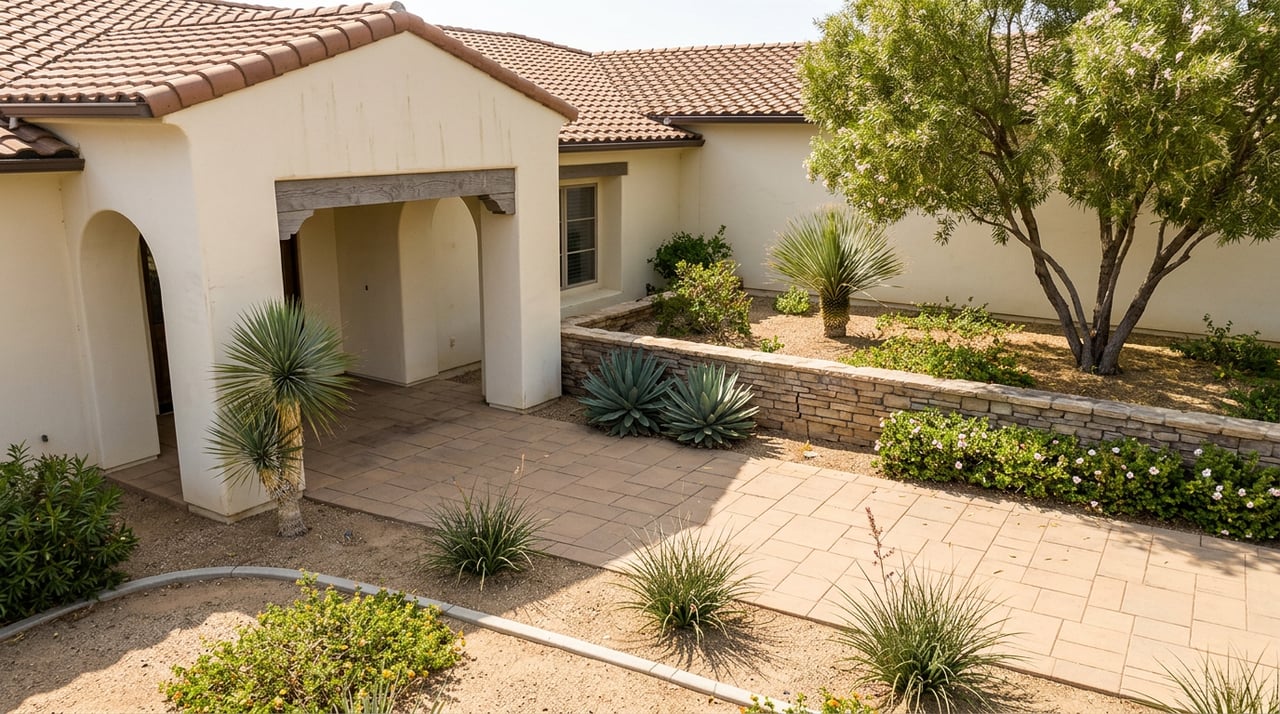
You've been comparing listings for a few weeks now, and something isn't adding up. One site shows Mesa Hills homes clustering in the high $200,000s. Another shows Upper Mesa Hills at nearly a million dollars. A third pulls up a number that's dropped 42 percent from last month. Same corner of El Paso's West Side. Same mountain views in half the photos. Wildly different math.
Here's the thing worth sitting with before you set a budget around any of these figures: the median price you're reading for either neighborhood is not describing a stable market. It's describing whatever handful of homes happened to close that month, and in both Mesa Hills and Upper Mesa Hills, that handful is a strange, lopsided sample. Understanding why changes how you should shop both places.
The Number That Should Make You Pause
Start with Upper Mesa Hills, because its median is the more dramatic case. One widely used home-value tool's most recent snapshot listed Upper Mesa Hills' median sale price at $833,944, a drop of 42 percent from the prior month but still up 125 percent from a year earlier. A separate home-value index, tracking the same neighborhood, put the January 2026 median at $915,000, up 157.7 percent year over year. Back in December 2023, a third snapshot from that same neighborhood showed a median of $480,000 at $180 per square foot.
Read those numbers again. They're not describing a neighborhood that appreciated steadily. They're describing a market so thin that whichever handful of homes closed in a given period swings the average by hundreds of thousands of dollars. A drop that large from one month to the next doesn't happen because buyers suddenly demanded less. It happens because the mix of homes that closed changed, and the "median" is just whatever sat in the middle of a tiny stack of closings.
Upper Mesa Hills is where you'll find the gated, view-lot enclaves that give the West Side its postcard reputation. One listing inside the Sanctuary at Sky Island, an exclusive gated community on this stretch of mesa, described unobstructed views of the Franklin Mountains, El Paso's Upper Valley, and Ciudad Juarez, along with a kitchen outfitted with a Wolf fryer and GE Monogram appliances. These are low-volume, high-variance sales. A neighborhood that might see only a handful of closings in a slow month simply doesn't generate a median that behaves the way a median should.
What's Actually Behind the Mesa Hills Number
Now flip to plain Mesa Hills, and the story reverses. Over the trailing 12-month window in the most recent reporting available, the median sale price sat around $282,400, up roughly 1 percent from the year before. That looks steady. It looks like the boring, reliable part of the market.
But look at what's being averaged. Mesa Hills, as most portals draw the boundary, includes a large stock of rental apartment communities: The Preserve at Mesa Hills, The Tuscany at Mesa Hills, and Retreat at Mesa Hills all sit inside the tract, alongside subdivisions like Crestmont Hills, the Coronado Townhouses, and the Montecillo Living complex of nine separate rental communities. One tracker's demographic breakdown for the area shows 81.6 percent of residents renting and only 18.4 percent owning. When four out of five households in a neighborhood are renters, the handful of single-family resale closings that do happen are competing for attention against a much larger rental inventory, and the reported "median home price" is describing a small, specific slice of the tract rather than the neighborhood as a whole.
So you get two names that sound like variations on the same place, producing two numbers that describe two almost unrelated products. One number is diluted by volume. The other is distorted by scarcity. Neither is lying, exactly. Both are technically correct and practically misleading if you take them at face value.
Two Names, Two Products
| Mesa Hills | Upper Mesa Hills | |
|---|---|---|
| What drives the reported median | High closing volume, heavily weighted toward apartment and rental-community comps | Very low closing volume, weighted toward a handful of custom estate sales |
| Typical housing stock | 1980s-90s apartment complexes, townhomes, tract subdivisions, a smaller share of single-family resale | Gated custom homes, larger view lots, occasional new construction |
| Why the number moves the way it does | Stays fairly flat because the rental base is large and stable | Swings by 40 to 150+ percent month to month or year to year because the sample is tiny |
| What it tells a buyer | Roughly what a modest resale home costs, if you can isolate it from the rental comps | Almost nothing reliable about what a specific home will cost |
The table isn't a ranking. It's a reminder that "median price" only means something when the sample behind it is large and consistent. In Mesa Hills, you need to ask what's diluting the number. In Upper Mesa Hills, you need to ask what's distorting it.
Questions to Ask Before You Trust a Median
If you're comparing these two neighborhoods, or any two neighborhoods that share a name and a border, here's what actually protects you before you write an offer:
- Ask how many homes the reported median is built from. A median from 30 closings behaves very differently from a median built on four.
- Ask whether the sample includes condos, townhomes, or multifamily units alongside single-family homes. In a tract like Mesa Hills, that mix matters enormously.
- Ask what the price-per-square-foot range looks like across recent closings, not just the single median figure. A wide range signals a lumpy, unreliable comp set.
- Ask whether any of the recent sales are inside a named gated community or custom subdivision. If so, ask whether that's the product you're actually shopping for, or whether it's skewing a broader neighborhood number that doesn't apply to what you can afford.
- Ask for the specific comps, not the aggregated stat. A local agent pulling MLS data directly can hand you the actual list of closings behind any number you've seen online.
None of this is complicated. It just requires treating a headline median the way you'd treat a single data point rather than a verdict.
What This Actually Means for Your Search
If your budget sits in the $270,000 to $350,000 range, Mesa Hills resale product, particularly in Crestmont Hills or similar subdivisions, is worth a serious look. Just don't let a blended neighborhood median convince you that every home in the tract is priced that way. The apartment inventory that surrounds those subdivisions has nothing to do with what a single-family resale will actually cost you.
If your budget clears $700,000 and you're drawn to the gated, view-lot product, treat any published median for Upper Mesa Hills as background noise rather than a pricing anchor. Ask specifically about recent closings inside the community you're interested in, whether that's Sanctuary at Sky Island or a comparable gated enclave on the mesa, and price against those, not against a citywide aggregate built on a handful of unrelated sales.
It also helps to put both neighborhoods against the wider market. Greater El Paso Association of Realtors MLS data showed a citywide closed-sale median of $290,087 for July 2026, up 7.7 percent from $269,383 a year earlier, while active listings fell to 3,401, down 15.9 percent year over year. That's a city where inventory is tightening and prices are climbing steadily, not spiking. Against that backdrop, a neighborhood-level median that swings 40 or 150 percent in a single reporting period isn't reflecting the city's actual trend. It's reflecting sample size.
Living With the Name Confusion
None of this is a reason to avoid either neighborhood. Mesa Hills sits above Interstate 10 with easy access to the Shoppes at Solana, home to the Jungle Reef aquarium and Urban Air Trampoline and Adventure Park, along with the Alamo Drafthouse Cinema. North Mesa Street carries a stretch of local shopping and dining, including Wake & Bake coffee shop and Malolam for Mexican food. Residents have access to Galatzan Park and Recreation Center, the Westside Natatorium, and Crestmont Park, and hikers head up the Thousand Steps Trail for a steep climb with views back toward downtown. Coronado High School sits near the intersection of North Mesa Street and Resler Drive, right in the heart of the area.
Upper Mesa Hills trades that walkable, amenity-dense feel for elevation, privacy, and unobstructed mountain and valley views behind a gate. Both are legitimate, different products. The mistake is letting a portal's aggregated median tell you which one you can afford before you've seen what's actually built into that number.
Frequently Asked Questions
Is Upper Mesa Hills always more expensive than Mesa Hills? Generally yes, since Upper Mesa Hills concentrates gated custom estates on larger view lots, while Mesa Hills includes a much broader mix of housing types. But the size of that gap, as reported by any single tracker, should be treated with caution given how few homes typically sell in Upper Mesa Hills in a given month.
Why do different real estate sites show such different numbers for the same neighborhood? Each site draws its own boundary for what counts as "the neighborhood," pulls from different data windows, and calculates medians differently. When the underlying sample is small, as it is in Upper Mesa Hills, minor differences in methodology produce large differences in the reported number.
Can I find a single-family resale home in Mesa Hills for under $300,000? Based on recent 12-month sale price data for the tract, yes, that price point sits close to the reported median. The key is confirming that a specific listing is a single-family resale and not being compared against the apartment and townhome inventory that also carries the Mesa Hills name.
If you're trying to figure out which of these two neighborhoods actually fits your budget and your list of must-haves, that's exactly the kind of comp-pulling, boundary-checking work our team does every week on El Paso's West Side. Reach out to Longenbaugh Group and we'll walk you through the real numbers behind whichever neighborhood you're considering, not just the headline median.